



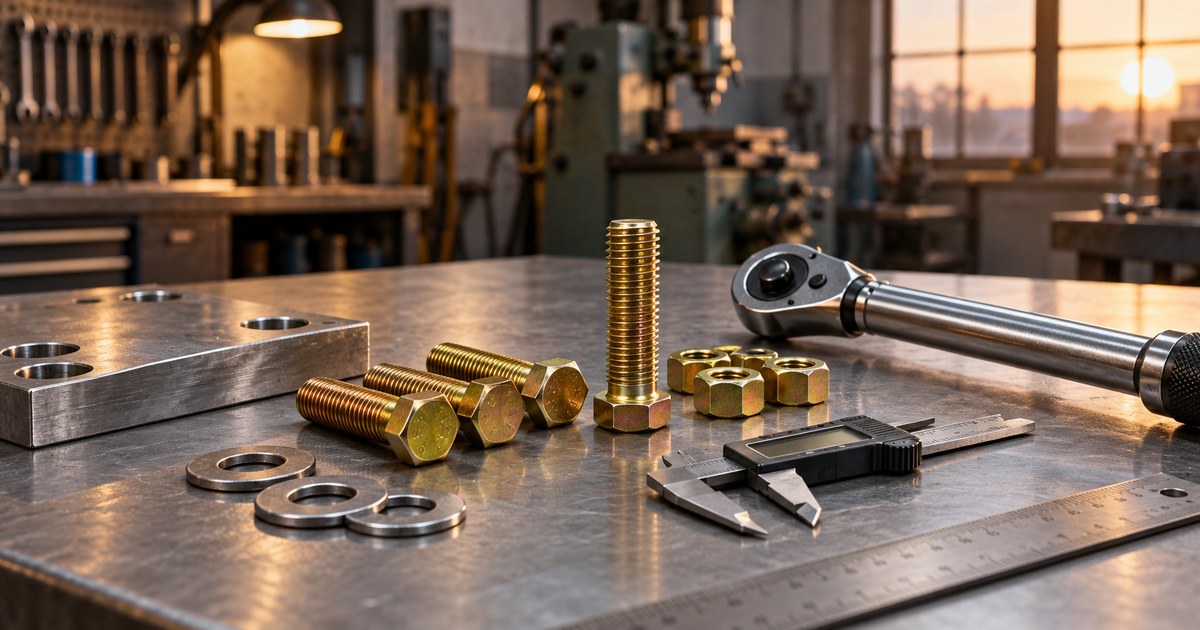
When you're bolting together a heavy equipment trailer hitch, securing a high-horsepower driveline flange, or mounting a suspension control arm on an off-road rig, using the wrong grade bolt isn't just an amateur mistake—it's a major safety hazard. Standard Grade 2 or Grade 5 bolts might look fine on the surface, but put them under severe torque or dynamic shear stress and they’ll stretch, deform, or snap clean off.
When maximum clamping force and high tensile strength are non-negotiable, mechanics and mechanical engineers reach for heat-treated grade 8 hex cap screws. Here is everything you need to know about Grade 8 hardware specs, head markings, and proper shop installation practices.
What Makes Grade 8 Fasteners So Tough?
The Society of Automotive Engineers (SAE) grades steel hardware based on its metallurgical mix, heat treatment, and real-world strength limits. Grade 8 sits right at the top of the strength ladder for standard imperial carbon alloy fasteners:
- 150,000 PSI Minimum Tensile Strength: Tensile strength measures the pulling force required to snap a bolt apart. Grade 8 beats Grade 5 (120,000 PSI) and Grade 2 (60,000 PSI) by a massive margin.
- 120,000 PSI Proof Load: Proof load is the maximum tension a bolt can endure without permanently stretching out of shape. Grade 8 bolts spring right back under intense load cycles.
- Medium-Carbon Alloy Steel Metallurgy: Grade 8 hardware is quenched and tempered at extreme temperatures to produce a dense, uniform grain structure that resists material fatigue.
- 6 Radial Head Dashes: You can identify a Grade 8 bolt in two seconds flat—look at the hex head. Six raised radial lines radiating from the center indicate a certified Grade 8 fastener.
Where You Should (and Shouldn't) Use Grade 8 Fasteners
Grade 8 bolts are engineered for high-stress mechanical joints. Knowing where to use them keeps your builds safe and reliable:
High-Stress Must-Use Applications:
- Automotive & Heavy Truck Suspension: Leaf spring shackles, control arm mounts, track bars, and sway bar links.
- Drivelines & Towing Assemblies: Fifth-wheel trailer hitches, pintle mounts, flywheel bolts, and driveshaft flange yokes.
- Heavy Equipment & Mining Rigs: Excavator bucket teeth mounts, hydraulic pump brackets, and crane boom pivot assemblies.
When NOT to Use Grade 8:
Don't waste money putting Grade 8 bolts on light sheet metal trim, non-structural plastic brackets, or electrical ground straps where Grade 2 or Grade 5 hardware works fine. Also, if you need extreme corrosion resistance in salt-spray or marine chemical environments, high-grade stainless steel (such as 316 stainless) may be required over zinc-plated carbon steel.
3 Critical Torque Rules for Grade 8 Installation
Installing high-strength hardware correctly is just as important as choosing the right grade. Follow these pro installation rules to get 100% of the holding power out of your bolts:
1. Always Match the Nut and Washer Grade
Never thread a Grade 8 bolt into a cheap Grade 2 nut or back it with a soft mild steel washer. The bolt head will crush a soft washer, dropping clamping torque, and the threads will strip right out of a low-grade nut. Always use Grade 8 hex nuts and hardened flat washers.
2. Know Your Dry vs. Lubricated Torque Specs
A dry 1/2-13 Grade 8 bolt calls for roughly 110 ft-lbs of torque. Apply anti-seize, oil, or threadlocker, and that lubricated torque spec drops to around 80-85 ft-lbs. Over-torquing a lubricated bolt based on dry torque charts can stretch or strip threads.
3. Use a Calibrated Torque Wrench
Guessing torque with an impact gun or breaker bar is asking for trouble. Always use a calibrated torque wrench and follow manufacturer torque sequence patterns on multi-bolt flanges and covers.
Stock your shop with certified Grade 8 hardware, follow proper torque protocols, and build every machine with complete peace of mind!